EN
EN



Matching Cable Types to Optical Transceiver Interfaces
How SFP+, QSFP28, OSFP, and COBO Interfaces Dictate Cable Compatibility
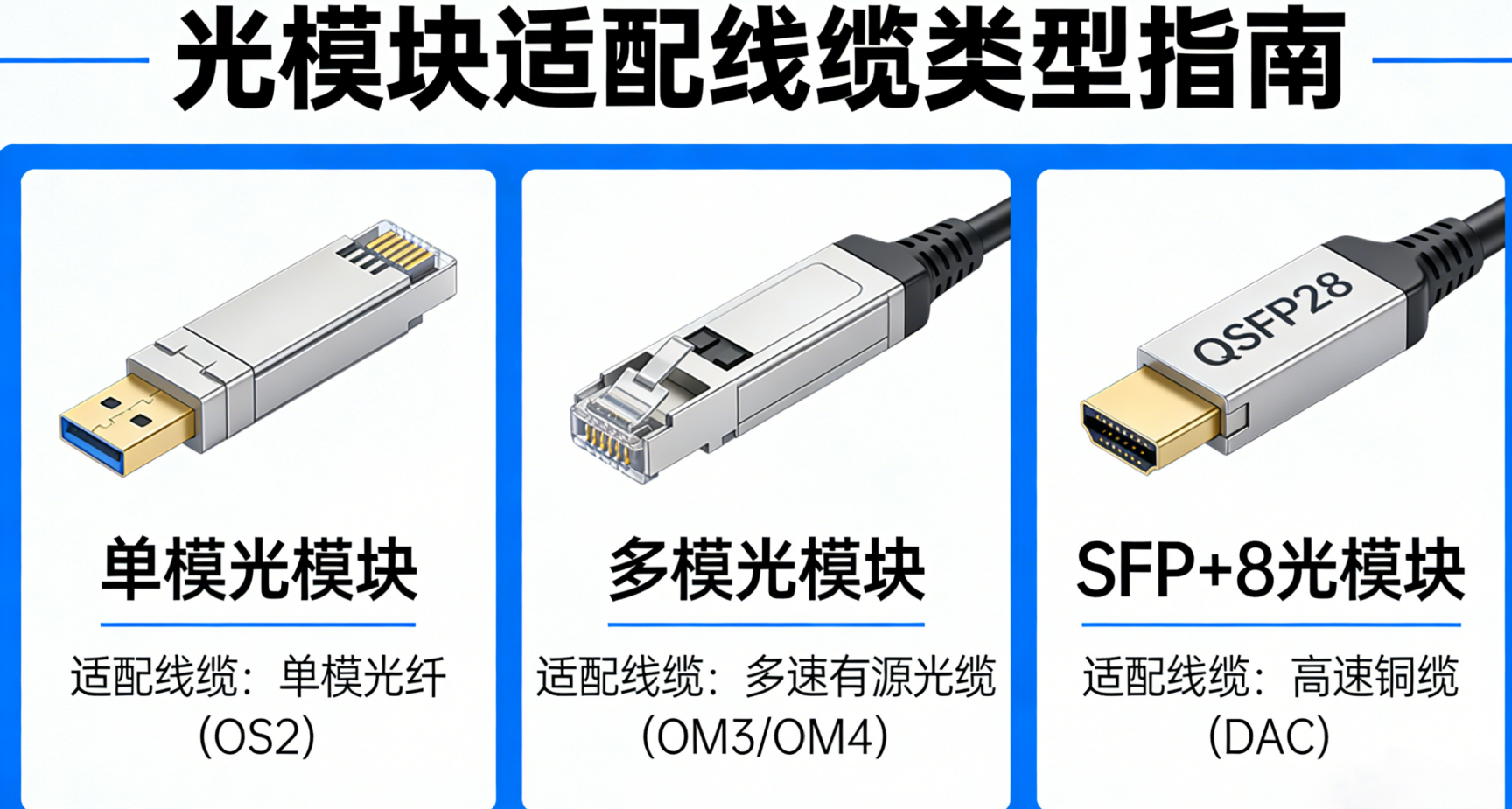
Different optical transceiver interfaces like SFP+, QSFP28, OSFP, and COBO come with their own specific requirements when it comes to physical space, electrical connections, and heat management, which all affect what kind of cables can actually work with them. The SFP+ ports handle speeds from 10G to 25G and take either LC duplex fiber or those passive or active Direct Attach Copper (DAC) cables most people know. Moving up to QSFP28 for 100G means dealing with denser MPO-12 fiber or DAC cables that need really careful impedance matching. Then there's the newer OSFP standard that supports massive bandwidths from 400G to 800G through deeper receptacles and better cooling systems. These require either MPO-16 cables or special twinax copper cables capable of handling over 56 Gbps per lane. And finally we have COBO, short for Consortium for On-Board Optics, which takes things even further by doing away with those plug-in connectors altogether. Instead, the optics get integrated right onto the switch's printed circuit board, meaning technicians need custom made board level cables instead of just swapping out parts in the field. Trying to force the wrong cable type, say putting an OSFP cable into a QSFP28 port, often results in damaged equipment because of size differences between the components, something the OSFP MSA Specification version 3.0 definitely warns against.
Electrical vs. Optical Signal Integrity: Why Cable Choice Impacts Link Budget and BER
The choice of cables plays a critical role in maintaining signal integrity, particularly when it comes to link budgets and bit error rates (BER). Copper Direct Attach Cables (DACs) tend to suffer from significant insertion loss, sometimes reaching around 30 dB per kilometer at speeds like 25 Gbps. These copper cables also get easily messed up by electromagnetic interference (EMI), which restricts their reliable operation distance to about 7 meters max. Optical fiber offers much better performance regarding signal loss. Single mode fiber (SMF) typically shows only about 0.4 dB per km, whereas multimode fiber (MMF) generally falls somewhere between 2.5 and 3.5 dB per km depending on the specific fiber grade and operating wavelength. But there's a catch with MMF at higher speeds - modal dispersion starts becoming a major contributor to BER issues once we go past 25G speeds, especially when distances exceed 100 meters. Recent research published in the IEEE Photonics Journal back in 2023 showed that OM5 fiber cuts down BER by roughly 60% compared to older OM3 fiber when running at 400G over 150 meters. This highlights the complex interaction between fiber bandwidth properties, dispersion characteristics, and how sensitive our transceivers actually are. When the total signal loss accumulates beyond what a transceiver can handle (like those common QSFP28 modules that need at least -12 dBm signal strength), problems arise from things like excessive cable losses or reflections causing jitter. That ultimately leads to packets getting lost permanently. So engineers shouldn't just look at basic data rates when evaluating systems. They really need to check actual cable parameters like attenuation levels, return loss measurements, and dispersion against the manufacturer's specified link budget requirements and compliance testing standards instead of relying solely on advertised speed capabilities.
Fiber Optic Cables for Long-Reach Optical Transceiver Links
Single-Mode Fiber (SMF) vs. Multimode Fiber (MMF): Distance, Bandwidth, and Dispersion Trade-offs
When looking at optical links beyond 300 meters, deciding between single-mode fiber (SMF) and multimode fiber (MMF) really comes down to three main factors: how far the signal needs to go, how much dispersion the system can handle, and what makes sense from a budget perspective. SMF has this tiny core size of around 8 to 10 micrometers which means it only carries one propagation mode. This eliminates those pesky modal dispersion issues and lets signals travel over 100 kilometers without needing repeaters, which is why telecom companies and metro network operators rely on it so heavily. Plus, SMF boasts pretty impressive low attenuation rates at about 0.4 dB per kilometer when operating at 1550 nm wavelengths. And when paired with dispersion compensating modules or coherent optics technology, we can push those distances even further. On the other hand, MMF fibers have much bigger cores ranging from 50 to 62.5 micrometers. They make it easier to connect with VCSEL based transceivers but come with their own headaches due to modal dispersion that limits actual working distances. For example, OM4 fiber might get us to 150 meters at 400G-SR8 speeds, whereas older OM3 fiber struggles to make it past 70 meters. Both fiber types deal with chromatic dispersion problems, though SMF's sweet spot at around 1310 nm wavelength combined with established compensation methods gives it an edge in performance margins. Even graded-index MMF tries to combat modal spreading through design improvements, but ultimately faces those unavoidable bandwidth-distance tradeoffs that come with multi-path signal propagation.
OM3/OM4/OM5 MMF Selection Guide for Data Center Optical Transceiver Deployments
For data centers limited to distances under 150 meters, OM3, OM4, and OM5 multimode fibers provide increasingly better performance when used with parallel optical transceivers such as SR4, SR8, or SWDM4. Let's look at the specifics. OM3 can handle 10 Gigabit Ethernet signals for up to 300 meters, while supporting 40 or 100GbE connections within 100 meters. OM4 takes things further by extending these ranges to around 400 meters for 10GbE and 150 meters for 40/100GbE because it has a much higher effective modal bandwidth rating of 4,700 MHz·km. Then there's OM5 which maintains compatibility with OM4 hardware but brings something extra to the table. It expands bandwidth capabilities between wavelengths 850 and 953 nanometers, making it possible to run shortwave wavelength division multiplexing (SWDM) for speeds ranging from 40 to 400GbE using just one fiber pair instead of multiple ones. At 953 nm wavelength, OM5 offers a minimum effective modal bandwidth of 6,000 MHz·km, so full 400G-SWDM4 operations work well within 150 meter distances with reduced fiber count and simpler cabling arrangements. Although OM5 typically costs about 20 percent more than OM4, this investment pays off since it prepares networks for upcoming transceiver technologies without needing expensive re-cabling projects later on. One thing worth noting though: proper matching matters a lot here. All these fiber types need careful pairing with specific transceiver emitters like VCSEL optimized multimode fiber rather than older LED grade options. Also important is ensuring correct wavelength settings during installation to prevent issues with differential mode delay that could degrade bit error rates over time.
Copper-Based Cables for Short-Reach Optical Transceiver Interconnects
For optical transceiver interconnects under 7 meters—such as intra-rack or adjacent-cabinet links—copper-based cables deliver compelling advantages in cost, power efficiency, and simplicity. They eliminate the need for optical-electrical conversion, reducing latency and component count while maintaining signal fidelity within their operational envelope.
Direct Attach Copper (DAC) Cables: Cost, Power, and Thermal Limits Up to 7m
DAC cables combine twinaxial copper conductors with those plug-in transceiver modules like SFP+ and QSFP28 to provide passive connections that have really low latency. These cables generally come out around 30 to 50 percent cheaper per port compared to buying both optical transceivers and fiber patch cables separately. Since there are no active components inside them, DACs don't consume any extra power and barely produce heat at all, which makes things much easier when designing cooling systems for dense server racks and switches. But there's a catch. The way they send signals electrically means they suffer from signal loss that gets worse as frequencies go up, plus interference between adjacent wires becomes a problem. That limits how far they can work reliably to about seven meters for 25G NRZ speeds and just three meters for 56G PAM4 connections. Once we get past five meters though, electromagnetic interference starts becoming a real issue especially if they're near power supplies that switch on and off or other radio frequency sources. And as data rates increase along with cable length, the cables themselves start getting warmer, so most manufacturers recommend adding heatsinks for anything above 25G when running continuously at full capacity.
Active Optical Cables (AOCs): Low-Latency, EMI-Resistant Alternatives with Extended Reach
Active Optical Cables come with tiny optical components inside their connectors, specifically VCSELs and photodiodes, which actually convert electrical signals into light right in the middle of the cable itself. What this means is they keep the same easy plug-and-play functionality as regular DAC cables but can stretch out much further distances, anywhere from 30 meters all the way up to 100 meters depending on how fast the data needs to travel and what kind of signal modulation is used. These cables have really low latency, adding less than half a nanosecond delay, and they don't get messed up by electromagnetic interference either. That makes them perfect for places like factory floors filled with machinery or areas near powerful radio frequency equipment. While AOCs do cost about 20 to 30 percent more than standard passive DACs, they save money over time because they generate less heat. The power consumption usually runs between 1.5 and 2.5 watts compared to around 3 to 4 watts for active DACs at similar speeds. Plus, since these cables handle vibrations better and aren't affected by grounding problems, they work especially well in applications such as high frequency trading systems or edge computing setups where every microsecond counts for performance.
FAQ
What are the main factors determining cable compatibility with optical transceiver interfaces like SFP+, QSFP28, OSFP, and COBO?
Cable compatibility is determined by requirements for physical space, electrical connections, and heat management specific to each optical transceiver interface. Using the correct cable type is essential to avoid equipment damage due to size differences among components.
How do copper Direct Attach Cables (DACs) compare to optical fiber in terms of signal integrity?
Copper DACs experience higher insertion loss and are susceptible to electromagnetic interference, limiting their operational distance. Single-mode optical fibers offer better performance with lower signal loss and longer reach, although multimode fibers are affected by dispersion at higher speeds.
What are the benefits of Active Optical Cables (AOCs) over Direct Attach Copper (DAC) cables?
Active Optical Cables use optical components within the cable to convert electrical signals into light, allowing for longer distances without electromagnetic interference. They maintain low latency and are more cost-effective in terms of power consumption and heat generation over time, compared to DACs.
Table of Contents
- Matching Cable Types to Optical Transceiver Interfaces
- Fiber Optic Cables for Long-Reach Optical Transceiver Links
- Copper-Based Cables for Short-Reach Optical Transceiver Interconnects
-
FAQ
- What are the main factors determining cable compatibility with optical transceiver interfaces like SFP+, QSFP28, OSFP, and COBO?
- How do copper Direct Attach Cables (DACs) compare to optical fiber in terms of signal integrity?
- What are the benefits of Active Optical Cables (AOCs) over Direct Attach Copper (DAC) cables?