EN
EN



Understanding Form Factor Compatibility and MSA Standards
Common Optical Transceivers Form Factors: SFP, SFP+, QSFP, and OSFP
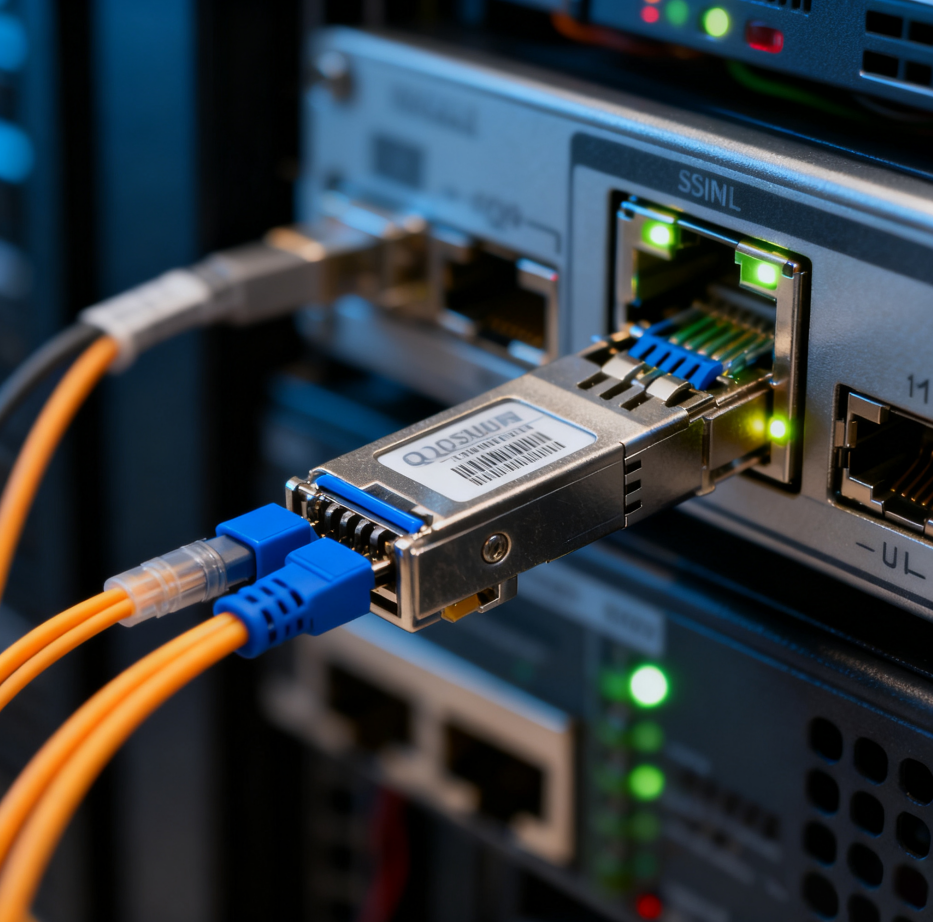
Optical transceivers come in standard physical shapes known as form factors that help different pieces of equipment work together. Take the Small Form-factor Pluggable (SFP) module for instance. These can handle speeds up to around 4.25 gigabits per second and are commonly used in things like connecting buildings within a campus network. Then there's the upgraded SFP+ version which pushes things further with speeds ranging from 10 to 25 Gbps, making it popular choice for modern data centers where fast switching is needed. When space becomes really tight in server rooms, companies turn to Quad Small Form-factor Pluggable (QSFP28) modules instead. These bad boys offer throughput between 100 and 400 Gbps, so they're basically essential for those massive cloud computing infrastructures we hear so much about these days. Looking ahead, newer options such as Octal SFP (OSFP) modules promise even faster speeds at 800 Gbps specifically tailored for artificial intelligence and machine learning tasks. However, most organizations haven't adopted these yet since they're still pretty much reserved for the bleeding edge tech setups right now.
Matching Transceiver Form Factors With Switches and Network Interface Cards
Most modern 1U rack switches these days come with either SFP28 ports running at 25 Gbps speeds or QSFP28 options. Older enterprise routers still hang onto SFP+ slots for their connections. Something worth keeping in mind when setting up networks: If someone wants to install Network Interface Cards compatible with OSFP standards, they need hardware supporting at least PCIe 5.0 x16 lanes otherwise they'll hit serious speed limits. Never skip reading those equipment specs sheets! Just because something like an SFP+ module looks like it fits into an older SFP slot doesn't mean it works there. The faster 10 Gbps transceivers simply won't operate properly in slower 1 Gbps ports since they speak different protocols underneath all that plastic casing.
The Role of Multisource Agreement (MSA) in Ensuring Interoperability
Groups like the SFF Committee, which includes around 92 manufacturers as of last year, set the rules for things like how optical transceivers are built mechanically, electrically, and thermally. The real value comes when different brands work together. Take this scenario: A Cisco QSFP-40G-SR4 module actually works fine in an Arista switch provided both follow the same IEEE 802.3bm standard and QSFP+ MSA guidelines. But there's a problem worth noting here. According to Dell'Oro research from 2023, about one third of all network failures related to transceivers happen because some equipment only partially meets these standards. That's why getting full certification matters so much in practice.
Addressing Vendor Locking Through MSA-Compliant Optical Transceivers
Most big name manufacturers stick to their own proprietary codes for transceivers, but genuine MSA compliant modules find ways around these limitations using standard EEPROM programming techniques. Look at third party options that meet both the SFF-8472 standards for diagnostics and SFF-8636 specs for management. According to testing done by FlexOptix last year, these alternatives perform almost identically to original equipment manufacturer products, showing about 99.6% matching performance in lab conditions. Companies that switch to these alternative solutions typically save between 40 to 60 percent on buying costs while still maintaining product reliability and getting proper warranty protection. The numbers speak for themselves when it comes to making smart purchasing decisions.
Data Rate, Wavelength, and Fiber Type Compatibility
Key Parameters: Data Rate, Wavelength, and Transmission Distance
Optical transceivers must align three core parameters for optimal operation:
- Data Rate (1G to 400G) defines bandwidth capacity, with higher rates requiring tighter wavelength tolerances.
- Wavelength (850 nm, 1310 nm, 1550 nm) determines transmission characteristics–shorter wavelengths (850 nm) suit multimode fiber for distances ≤ 550m, while longer wavelengths (1550 nm) enable single-mode spans up to 120km.
- Transmission Distance is constrained by fiber attenuation (≤ 0.4 dB/km for single-mode) and dispersion limits.
| Fiber Type | 10G Max Distance | 100G Max Distance | Optimal Wavelength |
|---|---|---|---|
| OM4 Multimode | 550m | 150m | 850 nm |
| OS2 Single-Mode | 40km | 10km | 1550 nm |
Optical Wavelengths Explained: 850 nm, 1310 nm, and 1550 nm Use Cases
Industry standards match wavelengths to specific applications:
- 850 nm VCSELs dominate short-reach (<1km) multimode links in data centers due to lower transceiver costs.
- 1310 nm DFB lasers offer balanced performance for single-mode connections up to 40km, minimizing chromatic dispersion.
- 1550 nm EML lasers enable ultra-long-haul DWDM networks by leveraging the low-loss C-band window for coherent 100G+ transmission.
Matching Optical Transceivers with Fiber Types: Multimode vs Single-Mode
Fiber core geometry directly influences wavelength selection and reach:
| Criteria | Multimode (OM3/OM4) | Single-Mode (OS2) |
|---|---|---|
| Core Diameter | 50µm | 9µm |
| Typical Use | ≤ 400m intra-DC links | ≥ 1km metro/access nets |
| Cost Profile | Lower transceiver cost | Higher fiber plant cost |
| Upgrade Path | Limited to 400G-SR16 | Scales to 800G-ZR coherent |
Wavelength Technologies: Grey, CWDM, DWDM, and Bi-Directional (BiDi) Modules
Networks employ advanced wavelength strategies to maximize fiber efficiency:
- Grey Optics: Single wavelength per fiber (e.g., 100G-LR4), simplest to deploy.
- CWDM/DWDM: Multiplex 18–96 wavelengths via Coarse or Dense WDM, increasing capacity up to 40x.
- BiDi Transceivers: Transmit dual wavelengths (e.g., 1310/1550 nm) over one fiber, reducing fiber count by half.
Vendor Specific Compatibility and Equipment Integration
Transceiver Compatibility with Major Brands: Cisco, Arista, NVIDIA/Mellanox
The big network companies have their own special ways of handling firmware and EEPROM coding when it comes to making sure transceivers work together properly. Take Cisco's DOM system for instance - it needs those specific vendor codes to be recognized by Catalyst switches. And then there's NVIDIA and Mellanox with their InfiniBand stuff which actually demands a wavelength tolerance that's about 30% tighter compared to what the standard MSA baseline allows. Looking at some recent research from 2023 shows something interesting too. About 62 percent of all problems related to transceivers happen specifically in setups where multiple brands are mixed together because the profiles just don't match up right between them.
Navigating Compatibility Matrices and Host Software Version Requirements
Vendor compatibility matrices specify supported transceivers by switch model and software version. Arista’s EOS 4.28+ introduced stricter optics validation, mandating temperature calibration tables for third-party QSFP28 modules—previously optional. Cross-reference key thresholds:
| Vendor | Critical Software Threshold | Required Transceiver Features |
|---|---|---|
| Cisco | NX-OS 9.3(5)+ | Enhanced DOM + Cisco SAFE ID |
| Arista | EOS 4.28+ | Extended DDM thresholds |
Balancing Standards Compliance with Vendor-Specific Restrictions
Although 78% of enterprises deploy third-party transceivers in multi-vendor networks (Ponemon 2023), MSA compliance alone does not guarantee seamless integration. Juniper’s “Enhanced Optics” mode adds layer-2 performance checks absent from MSA standards, necessitating programmable transceivers with 10% higher signal integrity margins than baseline requirements.
Best Practices for Integrating Third-Party Optical Transceivers
- Pre-deployment testing: Validate transceivers under peak traffic loads for at least 48 hours
- Firmware synchronization: Ensure DOM parameter ranges align with switch OS expectations
- Lifecycle alignment: Partner with suppliers offering firmware updates synchronized with your network upgrade cycles
A 2023 case study showed enterprises reduced compatibility-related outages by 83% after implementing vendor-specific buffered clocking configurations in third-party DWDM modules.
EEPROM Programming and Overcoming Vendor Lock-In
How EEPROM Enables Transceiver Identification and Authentication
The EEPROM chips inside optical transceivers basically act as their digital fingerprints, holding all sorts of important info like serial numbers, when they were made, and what other gear they work with. When network hardware boots up, it checks these chips to make sure everything's genuine. A recent study from last year found that this verification step stopped nearly half of those annoying setup mistakes in big company networks. But here's the catch: manufacturers sometimes sneak in their own special authentication codes into these memory chips, which makes it harder for different brands to play nice together. It's kind of like putting roadblocks where there shouldn't be any, just to keep customers tied to specific products.
Impact of EEPROM Coding on Switch Compatibility
Switch firmware compares EEPROM data against internal databases to validate transceivers. Mismatches can trigger "unsupported SFP" errors—even when the module meets technical specs. Industry analysis shows 30% of compatibility issues stem from EEPROM mismatches rather than functional defects, emphasizing the need for precise programming.
Strategies for Bypassing Vendor Lock-In Through Proper Programming
Third-party manufacturers now offer transceivers reprogrammed with standardized EEPROM codes aligned with SFF-8472 specifications. This approach maintains compatibility while reducing costs by up to 70% compared to branded modules. Recommended practices include:
- Verifying firmware version compatibility
- Using ISO 9001-certified reprogramming services
- Conducting pre-deployment signal integrity testing
Risks and Benefits of Reprogramming Optical Transceivers
| Advantages | Considerations |
|---|---|
| 60% cost savings vs OEM | Potential warranty voids |
| Multi-vendor deployment | Firmware update conflicts |
| Custom wavelength tuning | Requires compatibility validation |
A 2024 market survey revealed 68% of enterprises use reprogrammed modules in non-mission-critical links, though only 29% deploy them in core segments due to legacy support concerns. Always verify carrier-grade temperature tolerances (-40°C to 85°C) and DOM monitoring capabilities when selecting third-party transceivers.
Testing and Qualifying Optical Transceivers for Enterprise Deployment
Interoperability Testing Frameworks for Third-Party Optical Transceivers
Enterprise networks require rigorous validation of third-party transceivers using standardized testing frameworks. Industry-leading Ethernet testing platforms combine physical layer analysis with multi-flow traffic simulation to verify data accuracy across mixed-vendor environments. These systems assess error ratios (<1–10−12), latency consistency (±5%), and power dissipation compliance.
Supplier Qualification Checklist: Reliability, Support, and Compliance
Three pillars determine supplier viability:
| Factor | Enterprise Requirement | Verification Method |
|---|---|---|
| Product Reliability | <0.5% annualized defect rate | IEC 61753-1 compliance testing |
| Technical Support | <4-hour SLA for critical issues | Onsite spares inventory audit |
| Standards Compliance | Full MSA/IEEE 802.3 alignment | Independent certification docs |
Case Study: Deploying MSA-Compliant Transceivers in Multi-Vendor Networks
A global financial institution achieved 40% cost savings by replacing branded 100G QSFP28 modules with MSA-certified alternatives across Cisco Nexus 93180YC-EX and Arista 7280CR3 platforms. The deployment included:
- Pre-testing 200 units across four switch firmware versions
- Validating DWDM channel stability at 15 km intervals
- Implementing automated optical monitoring via SNMPv3
Ensuring Long Term Performance and Warranty Coverage
Proactive maintenance aligned with IEC 62379-2 recommendations extends transceiver lifespans beyond typical five-year thresholds. Leading suppliers now offer performance warranties covering:
- Output power degradation (>3 dBm margin)
- Receiver sensitivity drift (<0.8 dB variation)
- Firmware update compatibility guarantees
Third-party validation reports show properly qualified optical transceivers achieve 99.999% uptime in carrier-grade networks, matching OEM performance benchmarks.